
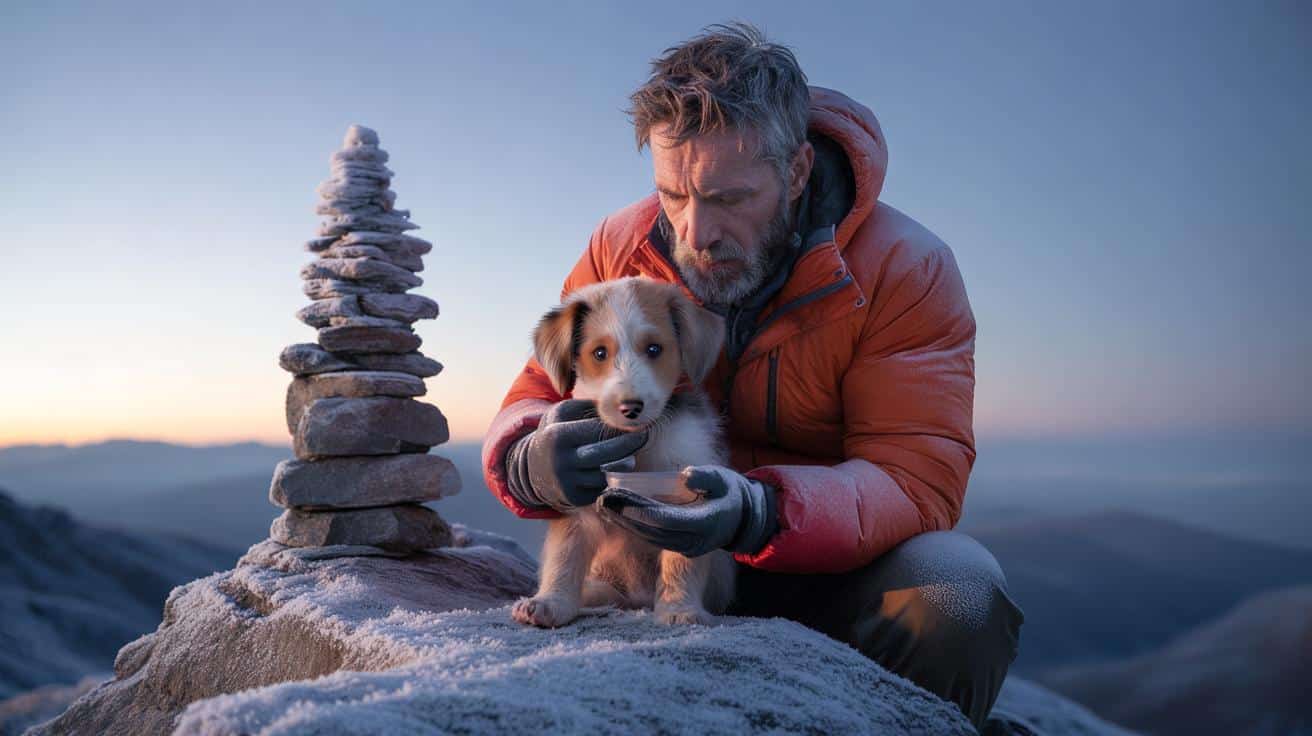
That’s the jolt at the heart of this story: grit and altitude, followed by a small, shaking secret curled in the rocks. It raises a quick, urgent question that doesn’t care about summit selfies or the day’s personal best — what do you do with life this fragile, this lost, at 2,000 metres? And what does it say about us when our most memorable trophy isn’t a view, but a heartbeat in our hands?
The wind cut straight through the fleece at the ridge, the kind that scrubs colour from your face and makes every thought sharper. Boots crunched on frost, the sky hard and bright like glass. He took the last steps to the cairn and stilled, expecting silence and the buzz of altitude. Instead, a sound like someone trying not to cry. A small whimper, almost polite. He turned, and there it was: a puppy, ribs like fine wires, tail unsure of the script. The animal blinked, as if embarrassed to be found. The man knelt, hand out, breath fogging. The puppy nosed his knuckles with a warmth that felt out of place on a morning like this. Then the whimper.
Above the treeline, a tiny question mark
There’s something disarming about finding youth where everything else is ancient. The summit was rock and old weather, a place stripped of fuss. And then — a pup. Not fierce, not heroic, just alive and a bit wobbly on oversized paws. The man felt the oddness of the scene, the way chance tucks itself into a day and changes its shape. He shrugged off a jacket, made a quick nest. The dog leaned in as if it had been practising for this exact moment, as if the mountain had been a waiting room and the appointment had finally arrived.
It’s not impossible. Hikers do stumble on animals in places that feel wrong for them. In the Alps, shepherding routes intersect with tourist trails. In the Highlands, dogs chase scents into mist. Rescue organisations in Europe report seasonal spikes in lost pets around holiday periods, when more people travel and trails are busier. We’ve all had that moment when a sound pulls at the edge of your day and asks you to make room. On a mountain, the ask is louder. At height, small problems loom large, and a puppy isn’t a footnote — it’s the headline.
How does a puppy reach a summit? There are a few paths. It could be a shepherd’s dog-in-training, spooked by thunder and wandering too far. It could be a pet that slipped a lead at a viewpoint and followed the wrong boots up. It could be a crueler story, the kind you hope isn’t true. Logic says this: puppies follow scent and movement; they don’t map terrain or forecast cold. They go where the last interesting thing went. A trail of picnics. A ribbon of human odour in the air. And once they’re off, altitude doesn’t feel like a number. It feels like one more corner to turn, then another.
What you do in the next ten minutes matters
First move: warmth. Wrap the puppy in dry layers, chest to your chest if it’s shaking. Check paws for ice balls or cuts, run fingers gently along the ribs and belly for tenderness. Offer small sips of water from a cupped hand — not too much, not too fast. If you’ve got a buff or spare sock, make a quick paw cover for sharp scree. Create a sling from a scarf or a jacket to keep the body close as you start down. Call local mountain rescue or a ranger line as soon as you have signal. Note the time, the exact location, and any signs of previous human presence like a lead, tag, or bowl.
Feed cautiously. Little dog, little stomach. A few bites of plain, high-energy food if you have it — a pinch of your oat bar is okay; chocolate is not. Keep movement steady and pauses short so the body doesn’t cool. Don’t post exact coordinates on social in the first hour; well-meaning crowds can stress rescue teams and wildlife. Let the puppy rest against your heartbeat, which is a metronome they recognise. Let’s be honest: nobody carries a full pet first-aid kit to the top of a mountain. The best gear you have might be kindness and a windproof shell. That goes a long way when conditions turn jittery.
Small rhythms help you make better decisions. Breathe, then plan the descent in stages: ridge, shelter, trailhead, vet. *Simple steps steady a panicked mind.* Keep checking for alertness and response to your voice. If the puppy’s breathing is shallow or the gums look pale, pick up the pace and call for assistance again when you can.
“On exposed ground, a found dog is a patient,” says a rescue volunteer in Snowdonia. “Think warmth, water, and a controlled exit. Everything else can wait until you’re off the mountain.”
- Microchip scan happens at a vet or shelter — it’s quick, free, and the fastest path to an owner.
- Carry a light emergency wrap year-round; a space blanket weighs grams and saves lives, furry and human.
- Photograph the puppy and the location markers for later, but keep your hands free during the descent.
Why this rescue lingers long after the boots dry
Back at the car park, the mountain looked softer, almost apologetic. The puppy slept in the man’s lap, twitching through drowsy dreams as if chasing something it finally caught. People walked by and smiled without meaning to. Stories like this travel quickly because they’re tidy knots of risk and relief. There’s a kind of private arithmetic at play: time lost from the route, weight added to the pack, breath spent on a whimper. In return, a quiet, stubborn joy. **A reminder that being strong isn’t just about going up; it’s also about carrying down.** Maybe the real headline is that we’re wired to respond when a small life asks us to show up. Maybe we crave proof of that wiring in a world that feels noisy and sharp at the edges.
Some will argue the man should never have been in that weather, or that the dog proves a wider problem of careless owners. Both may be fair. What sticks isn’t blame; it’s the image of a stranger’s jacket turning into shelter. It’s the way a mountain, carved by ice and time, can suddenly feel like a nursery. **Kindness isn’t complicated, but it often looks like work.** Those last stony switchbacks become a kind of vow you make with your feet — one careful step, then another, until the whimper stops sounding like worry and starts sounding like sleep. The world could use more of that music.
| Key Point | Details | Interest for the reader |
|---|---|---|
| Summit surprise | A hiker finds a puppy at the cairn in biting wind and creates warmth with a jacket nest. | Immersive, cinematic moment that invites empathy and curiosity. |
| What to do | Prioritise warmth, small sips of water, controlled descent, and contact rescue or a vet for microchip scan. | Practical steps readers can remember and use on any trail. |
| Why it matters | Rescues fuse risk, care, and community; they reveal a human instinct to carry what’s fragile. | Meaning that lingers beyond the click — sharable, reflective. |
FAQ :
- How do puppies end up at a summit in the first place?They can follow hikers, wander from shepherding routes, slip a lead at a viewpoint, or, in rarer cases, be abandoned. They follow scent and movement, not maps.
- Is it safe to carry a puppy down a mountain?Yes, if you keep them warm, stabilise them close to your body, and choose a steady route. Call mountain rescue if terrain or weather adds risk.
- What should I feed a found puppy on the hill?Small, plain bites only — think a corner of your oat bar or a bit of plain chicken if you have it. Avoid chocolate, onions, and rich foods.
- Who should I contact in the UK after the descent?A local vet for a free microchip scan, the council dog warden, and nearby shelters. If you found the pup in a national park, inform the ranger service.
- Can I keep the puppy if no one comes forward?Local rules apply, but there’s usually a holding period while owners are sought. After that, rehoming is considered. Be prepared for checks and paperwork.




This gave me chills—in the best way. The jacket-as-nest image is going to stick with me. Huge respect for choosing the ‘carry down’ over the ‘summit selfie.’ Did the pup end up microchipped and reunited?