
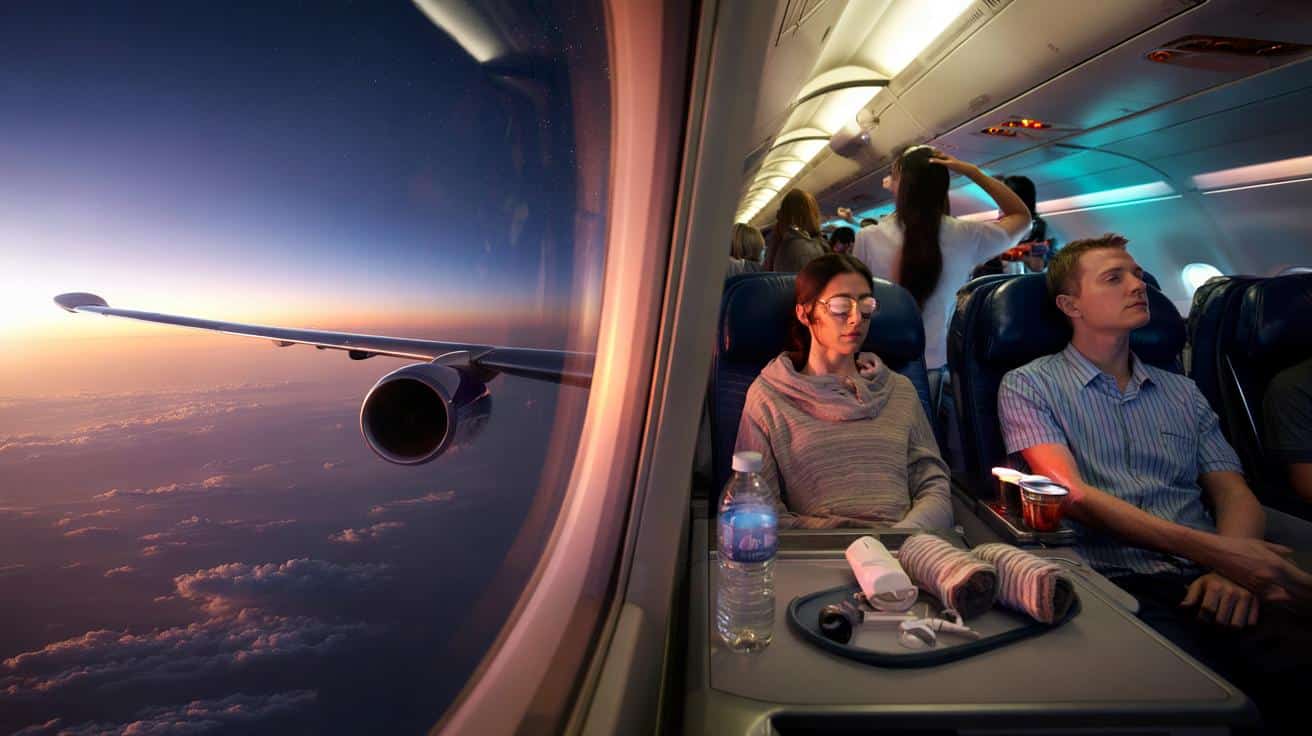
The world’s longest passenger flight has lifted off, a near-29-hour epic that turns a routine cabin into a floating village. Questions bloom with the jet stream: What happens to a body at hour 17? How do crews pace time when clocks lose meaning? And why chase a record that sounds a little impossible and a lot human?
The cabin lights dim, then glow, then dim again, as if someone is playing with the idea of day. A hush lingers on the aisle while the last batch of passengers find their seats, roll up hoodies, test neck pillows, and tap through the inflight menu like it’s a pact. The captain’s voice lands gently: extra crew on board, an amended route, meals in waves, medical staff watching data. A child counts the hours on their fingers and runs out of fingers. The plane eases into the night, big and quiet, engine note like a steady breath. Somewhere behind us, the terminal disappears. Ahead, nearly 29 hours of sky. And a question we can feel more than we can phrase.
29 hours in the sky: what it really feels like
Time stops behaving the way it does on the ground. On this **world’s longest flight**, you learn to live in slices: a film, a stretch, a nap that pretends to be a sleep. The cabin becomes a neighbourhood with soft rituals and unspoken nods, toothbrushes in the galley, socks traded for slippers, faces lit by screens that never quite sync with the sun. You keep moving because stillness feels louder up here.
At row 57, Maya starts a ritual: stand, walk eight aisles, sip water, write three lines in a notebook. Then she does it again. Cabin humidity sits around 15 to 20 percent, less than the Sahara on a breezy day, so lips and skin tell you to drink before your brain does. Modern long-range jets keep cabin altitude lower than the old days, which helps, but your heart still notes the press of thin air. Somewhere over a line on the map that people call the date line, the cabin tilts softly into a second morning. It feels like a trick, and a gift.
The logistics are precise in a way passengers only glimpse. Extra pilots rotate through bunk rooms hidden above the ceiling; cabin crew move like stagehands in a long play, timing service so a third of the cabin eats while a third sleeps and a third chooses a film they’ll abandon. Weight is the quiet boss: fuel, water, catering, even the number of blankets puts a price on range. The route dances around storms and traffic to sip less fuel, not more. In a way, the flight is a lab on wings, generating data on sleep, hydration, and how to keep a thousand small decisions from adding up to fatigue.
How to survive an almost-29-hour flight
Think in quarters, not hours. Break the journey into four mini-journeys and give each a job: movement, food, sleep, focus. Reset your watch to arrival time after take-off to nudge your brain. Anchor one proper sleep block with a mask, socks, and a layer you can shed. Then do a deliberate movement set each “quarter”: calf raises at your seat, a slow loop to the galley, shoulder rolls, six deep nose-breaths. *This is a marathon, not a sprint.*
Drink water early and often, and pair it with a light salty snack to keep it where you need it. Caffeine is a tool, not a mood, so time it for the first two “quarters” and skip it late. Alcohol feels friendly, then steals your sleep, so be kind to tomorrow-you. Screen bingeing is a trap if it eats into your best sleep window. We’ve all had that moment when the credits roll and the cabin is quiet and your brain is buzzing. Let’s be honest: nobody does that every day.
Small tech makes a big difference: a decent eye mask, foam earplugs, a scarf that doubles as a pillow, and playlists that loop like white noise. Pick one hour to write, draw, or clear photos from your phone, then close the apps like a ritual. The goal is to keep your **circadian rhythm** nudged, not bent.
“After the twelve-hour mark, you stop counting down hours and start counting small wins,” says the onboard sleep specialist, half-whispering in the galley. “Ten minutes of movement, thirty sips of water, one real sleep. Stack the wins.”
- Light: choose light on your face during your destination’s morning; shade down when it’s “night” there.
- Food: lighter meals late; protein earlier to keep you steady.
- Body: 20-20-20 for eyes; stand every 60–90 minutes if you can.
- Mind: one analogue thing — a book, a sketch, a page of notes.
- Seat: feet flat, hips back; a rolled hoodie can be a lumbar hero.
What this record says about the future of flying
A near-29-hour mission changes the map in people’s heads. It says time can be packaged differently, that distant cities can feel like neighbours if you pay close attention to human limits. Airlines see a frontier for ultra-long-haul, a niche where direct beats transfer and one take-off replaces two. Engineers see a new set of constraints: lighter cabins, stingier drag, smarter routing, more power from less fuel, and trials with **sustainable aviation fuel** blends that shave the footprint without grounding ambition. Travellers see a mirror. How much is comfort worth? How do we treat our bodies and our planet when convenience asks for more? The answers aren’t one-size. They live in the small choices — when to dim a cabin, what to plate on a tray, where to spend a mile of fuel — and in the quiet truth that flying this far is both ordinary and astonishing at once.
| Key Point | Details | Interest for the reader |
|---|---|---|
| Record duration | Nearly 29 hours gate-to-gate, operated as a one-off endurance mission with extended crew and tailored routing | Puts a number on what “ultra-long-haul” really means today |
| Human strategy | Quarter the journey; time sleep and light; hydrate and move with intention | Actionable tactics to feel better on any long flight, not just a record attempt |
| Tech and impact | Long-range widebody, efficiency-first planning, trials with new fuels and lighter kit | Why these flights exist, how they might evolve, and what it implies for cost and climate |
FAQ :
- Is this flight nonstop the entire way?It’s flown as a single mission with extended time aloft, using a long-range aircraft and special planning; the point is endurance, not connections.
- How many crews are on board for a near-29-hour flight?Pilot teams rotate through bunk rest to stay sharp, and cabin crew work in shifts so service and safety stay consistent.
- What’s the best way to manage jet lag on such a long sector?Align light and sleep to the arrival city, split the journey into four blocks, and protect one solid sleep with an eye mask and quiet audio.
- Can economy passengers really cope for that long?Yes, with a plan: choose aisle if you like to move, pack small comfort items, go easy on alcohol, and build micro-routines that give the hours shape.
- What about the environmental impact?Endurance flights are planned to sip less fuel per kilometre, with efficiency tweaks and SAF blends where possible, yet the footprint still matters and is part of the debate.





Almost 29 hours in one hop—wild. The piece really captured the “floating village” vibe. Curious which aircraft was used and how many bunks are in the crew rest?
Impressive, but what’s the climate math? Even with SAF blends and clever routing, is one ultra-long-haul better than two shorter legs in total emissions?