
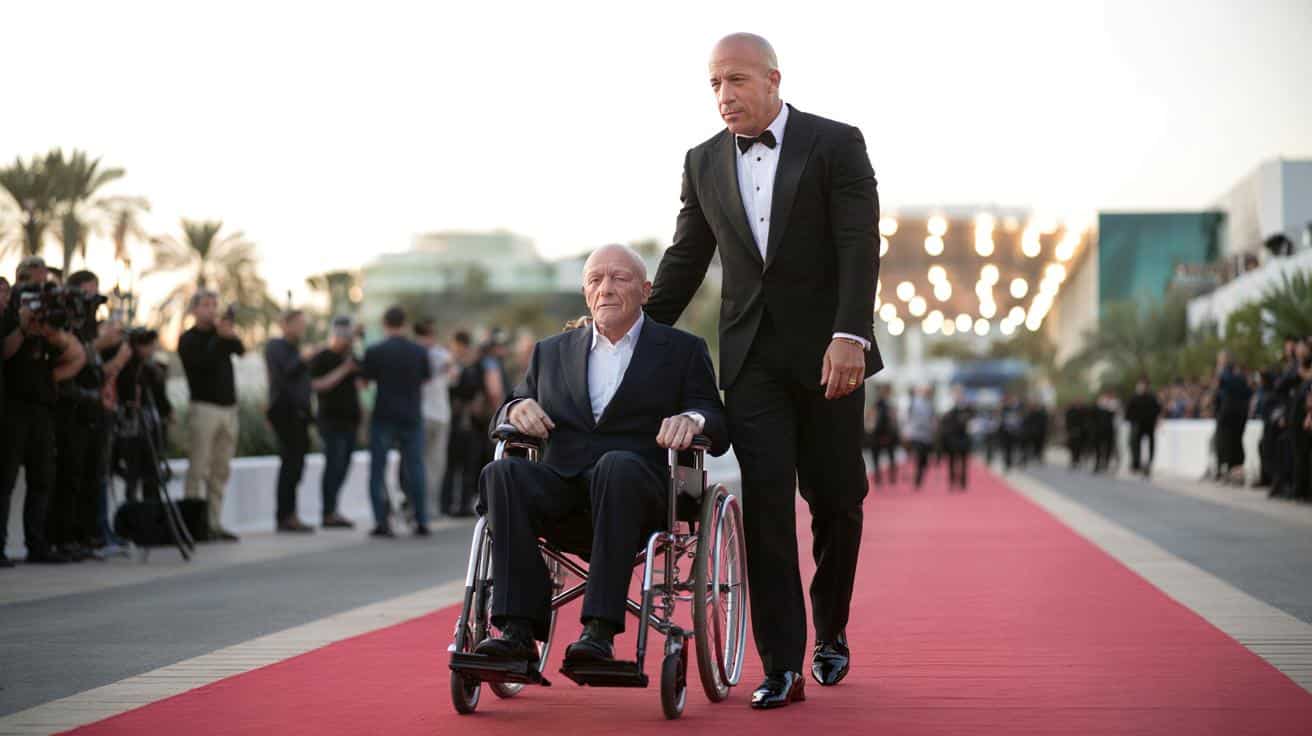
A-listers in tuxedos and sequins, a red carpet that glows like a stage light, and a small, human gesture that ripples far beyond the flashbulbs: Vin Diesel casually guiding Michael Caine’s wheelchair along the Red Sea festival carpet, and changing the mood of the night.
Then something gentler cut through the clatter. Vin Diesel, the action titan built for noise, placed both hands on the back of Michael Caine’s wheelchair and rolled him forward with an ease that felt… domestic.
The cameras snapped, of course. Yet a hush hung around the pair, like they’d stepped into their own pocket of air. Caine—serene, in his nineties—took in the crowd as if paging through a memory. Diesel kept pace, neither rushing nor posing. An old-school star. A modern guardian. Then he reached for the handles.
A quiet scene in a loud place
Red carpets are choreography. Publicists wave, photographers shout, and stars perform the micro-theatre of pausing, turning, smiling. Watching Diesel steer Caine through that tide felt like someone switching the soundtrack from subwoofers to strings. The festival lights glinted off wheelchair spokes, and people softened.
We’ve all had that moment when noise falls away and you see what matters. Onlookers nudged each other to make space, and a normally serrated press line loosened. Not a blockbuster beat, not a stunt. A simple frame of care inside the most mediated space in cinema. And it landed like a headline anyway.
Caine has long been a compass for British film grit and grace, Diesel a global avatar of speed and loyalty. Set against the Red Sea festival’s rising stature, their pairing felt oddly inevitable. A veteran of six decades. A franchise anchor. The image carried history and an invitation to read the room differently.
Why that gesture resonated far beyond the carpet
What you saw in that minute wasn’t just kindness. It was logistics, empathy, and status used as a tool. Accessibility on a red carpet is not glamorous on a call-sheet, yet it’s where festivals prove what they stand for. Wider margins, steadier pace, eye-level introductions—small tactics that recalibrate the whole walk.
Numbers sketch the stakes. The World Health Organization estimates 1.3 billion people live with a disability worldwide—about one in six. In the entertainment industry, representation has trailed that reality, which is why a single, respectful image can travel so far. It’s not a solution; it’s a signal that sets new expectations.
The Middle East’s flagship film festival has been building a brand on surprise guest lists and unguarded moments. This one worked because it balanced iconography with care. Two men from different eras created a frame that said: old becomes new when you make the route shared. **Access isn’t a side issue; it’s the stage.**
How stars quietly manage moments like this
There’s a craft to escorting someone through a live gauntlet. Stand slightly to the side so cameras can find the face, not just the back of the chair. Move at the guest’s pace. Keep your line of sight forward, scanning for dips and cables. Use your body to block the jostle, not the view. Simple. Precise.
Security can do this, but when a co-star or peer steps in, the energy shifts. The crowd reads it as respect, not risk. Let’s be honest: nobody really does this every day. That’s why rehearsal helps—festival teams can walk the route ahead, flag the snags, and plant a liaison who knows when to pause for a photo, when to roll.
There’s also tone. Don’t narrate the help, don’t make the person a prop, and don’t speed up for the cameras. **Slowness is a power move when everyone else is rushing.** It tells the room who sets the tempo.
Sometimes star power looks like stepping aside and holding space—so the legend gets the spotlight, and the moment earns its own applause.
- Choose a focal point: one photographer to anchor the stop-and-smile beats.
- Agree a hand signal for “pause”, “roll”, and “last frame”. It keeps chatter down.
- Brief the carpet crew on ramps, gradients, and Plan B exits. Drama belongs to the films.
The bigger picture that keeps unfolding
This image will live online as a loop, a GIF of grace, and it will pull in meanings it never asked for. Some will call it gallantry, some branding, some a necessary new normal for festival staging. All three can be true in the same frame. That’s why it stuck.
Red Sea is angling to be a memory machine—where global cinema merges with regional ambition and brittle glitz cools into real texture. **Real star power is a quiet muscle.** You felt that in how the carpet sound fell, in how the crowd widened without a word, in how a wheel track and shoe print ran side by side.
For a moment, the festival wasn’t selling a film; it was showing a value. And that’s the kind of clip audiences share not because it dazzles, but because it reminds them what dignity looks like under lights.
What it means for audiences, festivals, and the stories we’ll tell next
Audiences don’t just watch films; they watch how films arrive. The pre-show rituals now shape whether the story feels welcome in our lives. This one suggested a future where accessibility is designed in, not patched on. It’s warmer, cheaper, smarter—and it looks good on camera.
There’s a ripple effect, too. Marketing teams start adding access notes to call sheets. Venue partners invest in smoother ramps because they can picture the photo. Press lines adapt their bark to a softer cue. The optics aren’t the point, but they are the lever.
It’s easy to be cynical about celebrity choreography. It’s also easy to miss the practical knock-ons when a gesture catches. Imagine a season where elder icons attend more premieres because the route feels navigable. Imagine younger stars trained to share space without stealing it. That’s a culture shift, not a clip. It begins at the handle of a chair.
| Key Point | Details | Interest for the reader |
|---|---|---|
| Quiet care on a noisy carpet | Diesel guided Caine’s wheelchair at the Red Sea festival, setting a slower, respectful tempo amid flashbulbs. | Shows how small choices by stars can reframe an entire event’s mood. |
| Access as performance | Simple tactics—clear lanes, steady pacing, eye-level stops—turn inclusivity into part of the spectacle. | Practical takeaways for organisers, fans, and anyone staging public moments. |
| The ripple effect | One image encourages better planning, kinder crowd behaviour, and sharper brand storytelling. | Why this clip will keep surfacing on feeds and shifting expectations. |
FAQ :
- Did Vin Diesel actually push Michael Caine’s wheelchair?Yes—the actor was photographed escorting Caine along the Red Sea festival carpet, keeping a calm pace through the press line.
- Was this a planned photo-op?There’s no public confirmation of staging. The moment read as organic, with staff and photographers adapting on the spot.
- What does it say about accessibility at film festivals?Events are evolving. Visible, respectful support signals that access is part of the show, not an afterthought.
- How did the crowd react?Onlookers eased back, the noise dipped, and photographers captured frames that felt more portrait than scrum.
- Why did the image go viral so fast?It blends star power, intergenerational respect, and a rare softness on a red carpet—catnip for social feeds.


At the Red Sea carpet, this was the frame that mattered: quiet heroism from Diesel, pure grace from Caine. No fuss, just care. More of this on carpets everywhere.