
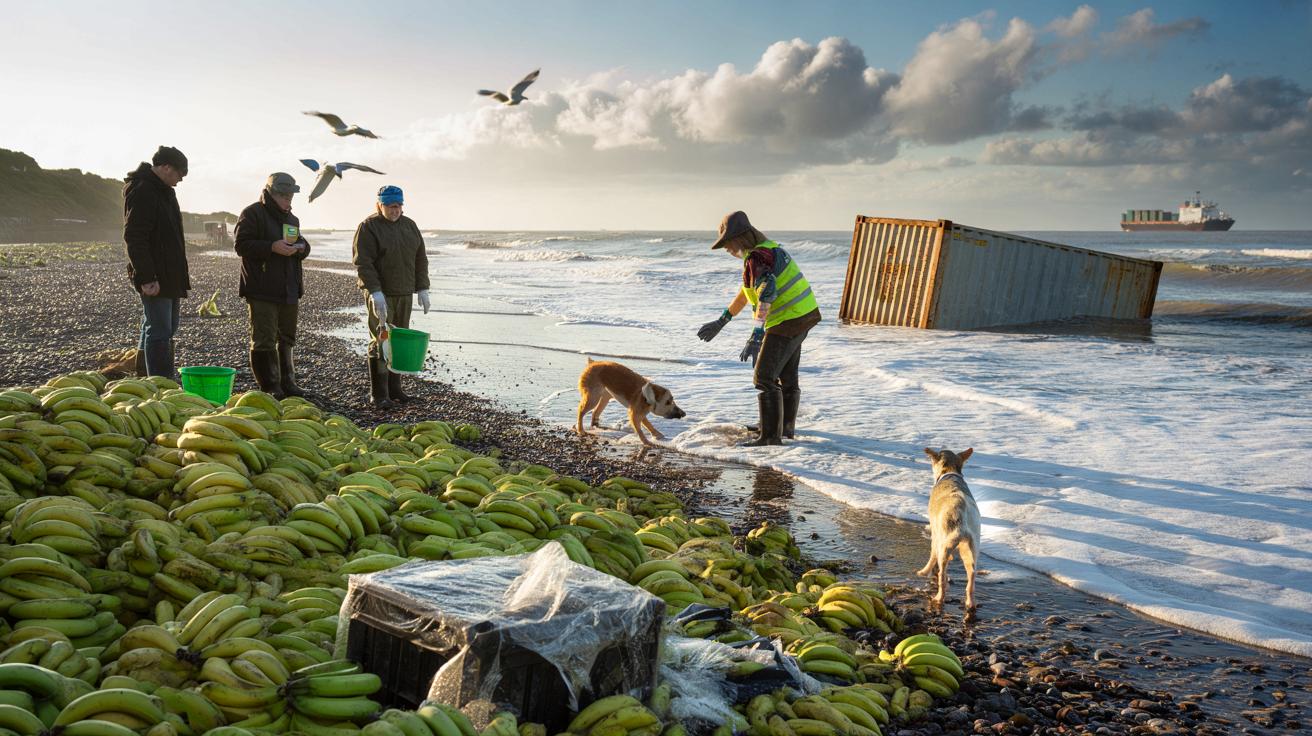
A cargo mishap has turned a quiet stretch of coastline into a surreal, banana-yellow mosaic — a feel-good photo opportunity with a harder edge: safety, law, and the sobering truth about how our stuff moves across the planet.
Gulls hovered, locals pointed, and a dog did a delighted dance around a knot of yellow, while a volunteer in a high-vis waded ankle-deep, shaking his head as if the sea had played a prank. The air smelt faintly green and sweet, the way a supermarket storeroom does before opening time.
People started to arrive with buckets and phones, half clean-up, half carnival. A council ranger stretched blue tape in a tired zigzag and asked parents to keep kids out of the surf. It looked playful, but the sea was telling us something. Then someone spotted the battered corner of a shipping container spinning in the trough, as casual as a floating door. The story starts offshore.
When cargo meets coastline
From a distance it looked like confetti, a cheerful mess scattered by a generous tide. Up close, you saw the scuff marks, the barcode stickers, the metal strapping, the sheer industrial scale of what had cracked open. A wave slapped, a clump of fruit thudded on shingle, and a fork of sunlight found the slicks of torn plastic. By noon, the beach looked like a produce aisle tipped on its side.
A surfer coming in from the point said he’d dodged a plastic pallet and a green sticker that read “Class 1 – Perishable.” He’d never seen so many bananas outside a market, and not one was ripe. Past spills have sent trainers, cereal boxes and Lego bricks to British shores, each landing like a message in a bottle. Industry data suggests container losses hover around one to two thousand a year worldwide, a small number against millions moved, yet big enough to stitch surprises into coastlines from Devon to Zeeland.
Bananas usually travel “reefers” — refrigerated containers stacked like chilled bricks, lashed and logged. Storms twist that neat geometry, wind and swell yank lashings, and the odd unit breaks free. Packaging gives extra buoyancy, and so boxes behave like reluctant boats, drifting on currents and washing in along predictable arcs mapped by oceanographers. Here’s the knotty bit: cargo might be insured and owned, but the sea doesn’t know the paperwork. So clean-ups become a dance between law, safety, and the strange thrill of seeing the global supply chain in pieces at your feet.
What to do when the tide brings cargo
If you’re tempted to pitch in, start simple: call HM Coastguard or your local council to log what you’re seeing, and share a precise location. Then keep your hands safe — gloves, sturdy shoes, and a mindset that treats every item as if it’s been in a chemical bath. Work above the wash line with others, build small piles in easy-to-collect spots, and photograph labels for reporting. If you pick it up, you must report it.
Common mistakes look harmless in the moment: kids carrying crates as trophies, dogs chewing plastic wrap, people wading into rough water to “rescue” bananas. We’re drawn by novelty, and we underestimate the risk of a live sea. Let’s be honest: nobody really files a formal report before picking something up on the beach. Think of it as part of the story you can tell later — the responsible kind, where nothing and no one gets hurt, and where the council and Receiver of Wreck don’t have to chase photos on social media to work out what happened.
Eating the fruit is a bad idea. Cargo can be treated post-harvest, sprayed against mould, and then salted by the sea on top. Do not eat washed‑up produce.
“Treat any washed-up goods as potentially contaminated, and report them. The law doesn’t change with the tide.”
- Call HM Coastguard (999 from the shore in the UK) and your local council’s environmental team.
- Report finds to the Receiver of Wreck under the Merchant Shipping Act 1995 within 28 days.
- Wear gloves; keep pets and children clear of the surf line and anything sharp.
- Photograph labels and serials; avoid hauling heavy crates alone.
- Leave hazardous items; if in doubt, step back and wait for trained crews.
A yellow warning for a blue planet
We’ve all had that moment when a small, ridiculous detail carries the weight of a bigger story. A banana on a British beach is that detail: cheerful colour, serious cause. The supply chain has become so fast and frictionless that its rare snags feel like theatre, but the backstage is creaking — more extreme weather, bigger ships, tighter schedules, and a system that absorbs losses until it can’t. Insurers will adjust, shipowners will review lashings, coastal teams will sweep and tally, and locals will swap stories about the day the sea went fruity.
This isn’t a morality tale about modern life being wrong. It’s a nudge to look closer at what “away” means when we throw things, make things, or ship things. Bananas travel thousands of miles to land on our kitchen counters still a little green. On this day, they travelled a few metres too far. The dominos behind that extra distance are worth our attention — not to feel guilty, but to get smarter about what we share with the ocean, and what it sometimes sends back.
| Key Point | Details | Interest for the reader |
|---|---|---|
| Why did containers fall overboard? | High stacks, rough weather, shifting loads and lashings under strain; a small percentage fail during storms and heavy seas. | Explains how a global system hiccups into a local spectacle. |
| Is it legal to take items from the beach? | In the UK, anything from a wreck must be reported to the Receiver of Wreck; keeping items without reporting can be theft. | Stops a “free for all” becoming a legal headache. |
| Is the fruit safe to eat? | No — potential chemical treatments, fuel residues and seawater contamination make it unsafe, even if it looks fine. | Protects health and avoids a nasty surprise later. |
FAQ :
- Can I take a banana home if I found it on the beach?Not without reporting. In the UK, report wreck material to the Receiver of Wreck; unreported salvage can be classed as theft.
- Who pays for cleaning the beach?Local authorities coordinate, often reclaiming costs from insurers or the ship’s owners where possible; volunteers usually help with safe litter-picks.
- How common are container losses at sea?Industry figures suggest roughly one to two thousand containers are lost each year worldwide, a tiny fraction of total traffic but enough to create eye-catching incidents.
- Why were the bananas so green?They’re shipped unripe in refrigerated containers and gassed to ripen closer to the shelf; what you saw were pre-ripening, export-grade clusters.
- What should I do first if I come across a spill?Call HM Coastguard, step back from the waterline, keep pets away, and wait for guidance; join organised clean-ups rather than improvising in the surf.




Plot twist: the ocean ordered curbside pickup and got curbside drop instead. Funny photos, sure, but it’s still polution and wildlife risk—let’s not turn it into a free-for-all.
Thanks for the clear safety pointers—call Coastguard, report to the Receiver of Wreck, and absolutely do not eat the fruit. Practical and level-headed.