
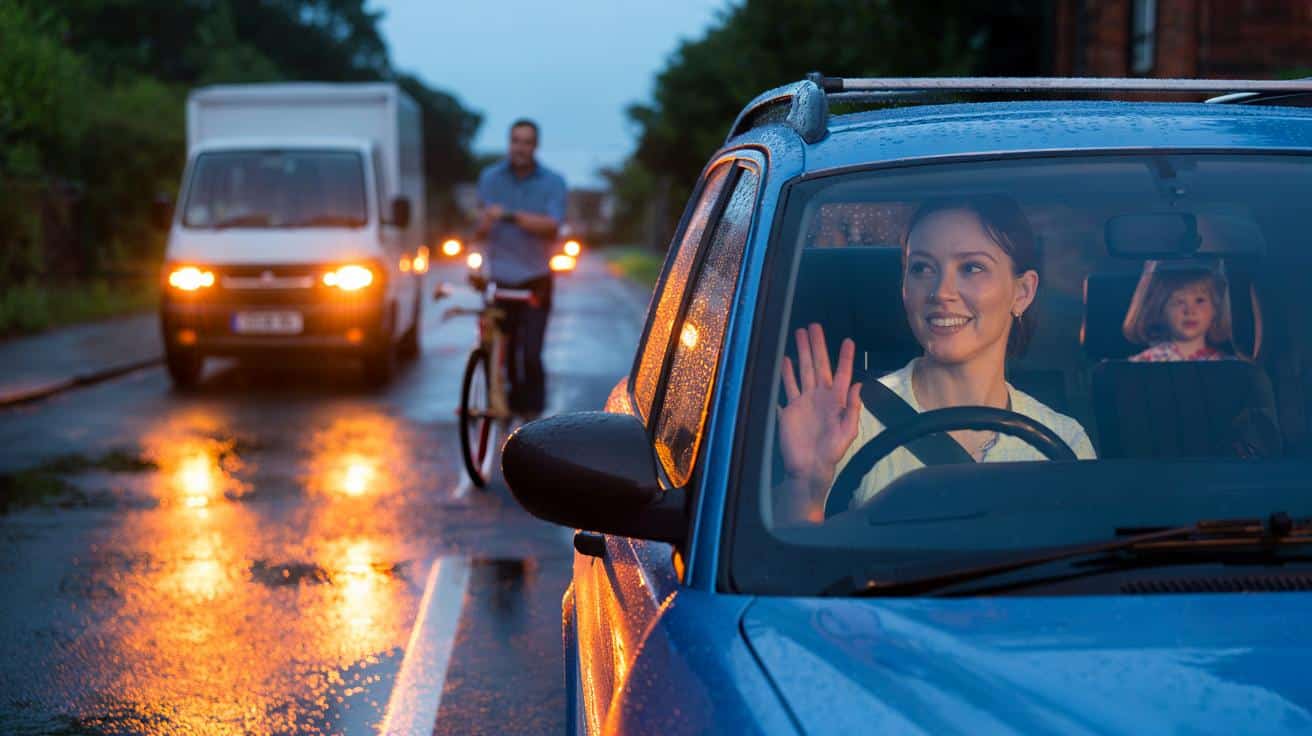
A quick palm lifted above the steering wheel. A nod through a smeared windscreen. That tiny “cheers” to a stranger cuts through traffic like a relief valve — and, psychologists say, it quietly reveals the kind of person you are.
The rider darts past, flicks a small wave, and the driver’s shoulders loosen just a touch. The lights change, the puddles glow orange, and the street exhales as if someone opened a window in a stuffy room.
Watch for five minutes and you’ll see it everywhere — a flash of hand, a quick smile, a nod so small it would miss on CCTV. You feel the room-temperature of the road lift by a degree. A tiny ritual, over and over, gluing the city together when we’re at our most impatient.
Why does that wave tell a story about you?
What the thank-you wave really says about you
That flicked hand isn’t just etiquette; it’s a personality broadcast. Psychologists often link everyday prosocial gestures to traits like agreeableness and an internal locus of control. If you wave, you’re signalling you notice others and believe your choices shape the moment, not just fate or luck.
It’s reciprocity made visible — “you helped me, I see you.” The brain likes tidy endings. A wave closes the loop, dials down threat, and makes two strangers feel less like obstacles and more like neighbours.
Picture a school run on a narrow street in Leeds. A mum edges her estate car into a gap and a van waits, engine ticking. She gives a brisk wave; the driver grins and taps the dash. The mood flips from “squeeze” to “we’ve got this”.
Later, the same road, no wave. You feel the air thicken. The van creeps closer, eyes hard, the estate jolts forward, and someone mouths something they wouldn’t say in front of their kids. Nothing huge happened. Yet everything did.
Behavioural researchers talk about “micro-affirmations”: tiny cues that say “we’re playing the same game.” The thank-you wave is one of those. People who make a habit of it tend to score higher on measures of cooperation and rule-keeping, the bones of agreeableness and conscientiousness.
Extraversion can shape the style — a big grin versus a small nod — but the core message is the same. If your stress is running hot, the gesture often disappears. That’s not cruelty; it’s bandwidth. The wave returns when your nervous system does.
How to turn a small gesture into smoother streets
There’s a craft to a good thank-you wave. Keep your palm visible above the wheel, hold for half a second, add the hint of a smile, then return to driving. That’s it. If you’re on a bike, a quick wrist flick or head dip reads clearly and keeps your hands safe.
On foot, a compact wave with your elbow close signals warmth without theatre. Try catching the driver’s eye, then dropping your hand early so it doesn’t feel like a demand. It costs nothing, yet it changes the whole tone of the road.
Common trip-ups? Overselling it. A huge, sarcastic arm-swing can land like a mockery, especially if someone’s already tense. A wave that’s too late looks like a scold. A stare can feel like a challenge when both of you are already wound tight.
Let’s be honest: nobody actually nails this every day. If you missed your chance, press reset at the next junction. If they don’t wave back, let it go like a song on the radio you didn’t choose. Your gesture is for the space, not the scoreboard.
The deeper trick is to treat the wave as a habit, not a performance. You’re building a micro-identity: “I’m the person who acknowledges.” That identity sticks on days when you’re tired, late, or a bit fed up. It becomes your default.
A tiny gesture can shift an entire street’s mood. As one traffic psychologist put it,
“Gratitude on the road isn’t a transaction. It’s a signal that you’re safe to cooperate with.”
If you like labels, the thank-you wave often aligns with these profiles:
- Agreeableness: warmth, trust, ease with cooperation.
- Conscientiousness: respect for norms, predictable cues.
- Internal locus of control: belief your choices matter.
- Lower social dominance drive: less need to “win”.
- Emotion regulation: capacity to downshift irritation.
A tiny ritual with a big ripple
We’ve all had that moment when a stranger’s kindness felt like a hand on your shoulder. The wave is the motoring version — soft power in a hard, metallic space. Multiply it by a thousand intersections and you change the feel of a city block by block.
It’s not magic. It’s signalling theory and social glue meeting wet tarmac and dodgy wipers. On a road filled with stressors you can’t control — delays, closures, the driver who turns without indicating — the wave is one of the few levers you can actually pull.
When you pull it often, you teach the people around you to expect better. Some will mirror you immediately. Some won’t, at least not today. Behaviour spreads unevenly and then all at once. The road, like any public space, is a culture you help write in real time.
If you zoom out, the thank-you wave is a referendum on how we want to share shrinking space. Do we lean into the elbows-out shuffle, or do we take the two seconds that tell others they’ve been seen? One choice cools the air. The other raises the temperature.
On weekdays we tend to forget we’re neighbours dressed as drivers. The wave reminds us. It’s a pocket-sized act that says, “I’m not trying to win, I’m trying to move with you.” That’s not soft. That’s smart.
| Key Point | Details | Interest for the reader |
|---|---|---|
| The wave signals prosocial traits | Linked with agreeableness, conscientiousness, and a sense of agency | Understand what your habits quietly say about you |
| It stabilises tense moments | Closes social loops, reduces threat, and stops escalation | Fewer frayed nerves, smoother journeys, safer decisions |
| Habits reshape road culture | Micro-affirmations invite imitation and set local norms | See how your small actions change the vibe of your commute |
FAQ :
- Is the thank-you wave universal?Mostly, yes. The exact form varies by country, but a brief, open-handed gesture usually reads as friendly acknowledgement rather than challenge.
- Does waving actually reduce road rage?It can take heat out of a moment by signalling cooperation. It won’t fix deep conflicts, yet it often prevents friction from snowballing.
- What if I can’t take my hand off the wheel?Try a small head nod or a smile visible through the windscreen. Cyclists often use a wrist flick; pedestrians can lift a hand low and quick.
- Is not waving a red flag about someone’s character?Not on its own. Fatigue, distraction, or stress can suppress nice habits. Patterns over time tell you more than any single moment.
- Can the gesture be misread?Large, late, or sarcastic movements can look snarky. Keep it small, early, and warm to avoid crossing wires.

Interesting link to internal locus of control. As a cycling comuter, I’ve found the quick palm lift defuses tense merges more than any horn or light. Curious if the effect persists when traffic density spikes, or if stress simply mutes the gesture regardless of personality?