
Not just coping, but adapting. The question now is whether we’re watching evolution flicker in real time.
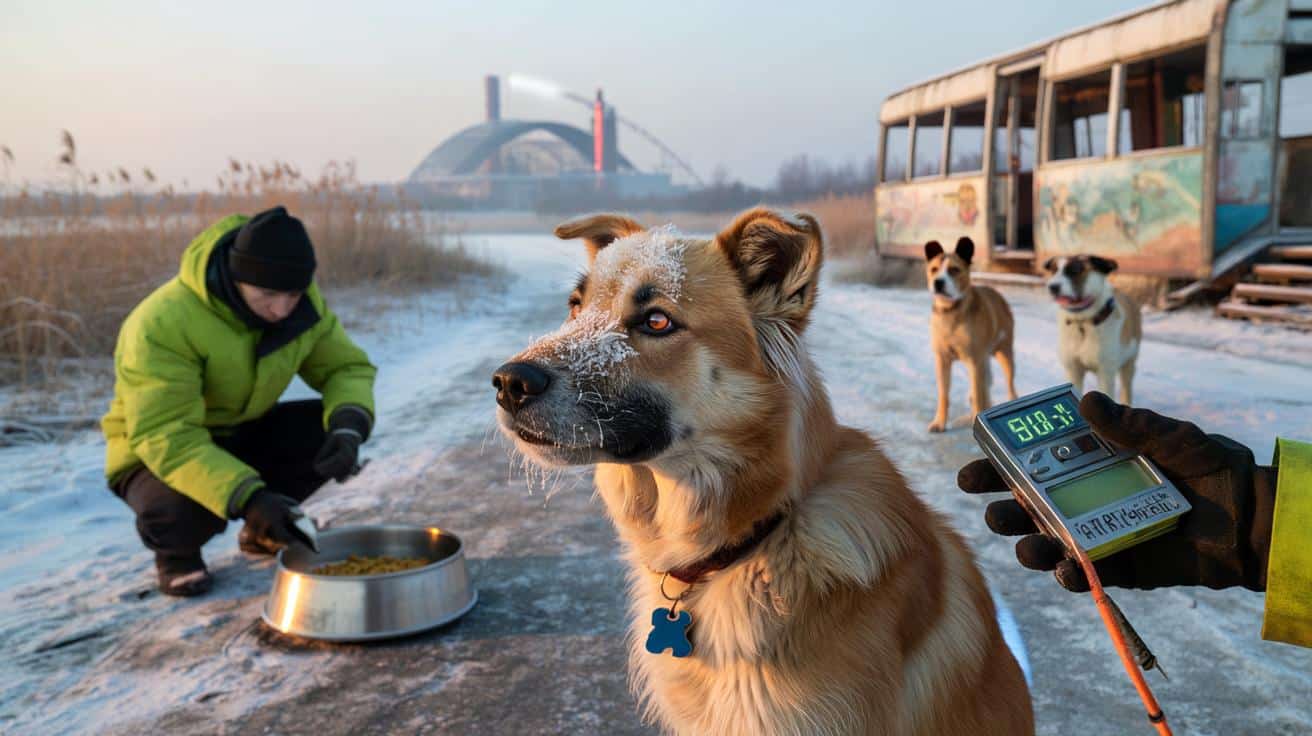
The dawn comes late in Chernobyl. Frost paints the bent reeds along the Pripyat River, and the air has that clean, empty sharpness that makes your breath a little louder. A tan dog with one ear cocked pads out from behind a concrete barrier, nose high, reading a wind that carries metal, pine, and the vague memory of people. A volunteer in a high‑viz jacket whistles softly and lowers a bowl. A Geiger counter ticks like a metronome that never learned restraint. Nearby, a researcher clips a tag to a collar and jots a note: location, radiation dose, coat condition. The dog eats, glances up, then melts back into the ruins like a rumour that didn’t want to be proved. The day begins with small acts of trust. The genome remembers.
Chernobyl’s dogs and the case for fast‑track evolution
Scientists studying the dogs scattered around the nuclear plant and the town have reported something striking: the animals closest to the reactor look genetically distinct from those living kilometres away. That pattern suggests more than a random jumble of strays. It looks like a population taking shape under unusual pressure—food scarcity, cold, and chronic radiation—where only certain traits get to roll the dice again.
In one major field effort, teams sampled blood from more than 300 dogs between the plant and Chernobyl city, mapping family ties and comparing them with reference genomes. The nearer the power station, the more the DNA clustered into a recognisably separate group, as if the Zone itself were drawing a boundary. Dogs live fast: a litter at two years, another soon after. That means the evolutionary clock can tick loudly within a human decade.
What counts as “rapid” here is grounded in maths and survival, not sci‑fi. Selection can act on standing variation—traits already in the gene pool—when conditions are harsh and consistent. Researchers are combing the dogs’ DNA for signals in pathways linked to DNA repair, oxidative stress, immune response, and metabolism. **Radiation is not the only force shaping them.** Cold winters, competition, and the odd kindness from people all twist the dial. If selection beats drift, today’s quirks become tomorrow’s normal.
How scientists trace change, and how readers can keep their heads
To test a claim like “rapid evolution”, researchers build a chain of evidence you can follow. They map where each dog lives, log dose rates in the ground and on fur, and record age, body condition, and behaviour. Then they sequence the genomes, scan for genetic differences between high‑ and lower‑dose areas, and run statistics to see if any gene regions stand out more than chance would allow. It’s stepwise, patient, and oddly intimate work.
The rest of us can read these findings without falling for mutant myths. Watch out for headlines that turn “genetic differentiation” into “three‑headed puppies”. We’ve all had that moment when a punchy line grabs us, and the nuance falls away. Look for sample sizes, controls, and whether the study tracks the same families across years. **Let’s be honest: nobody really does that every day.** Still, two slow minutes with the methods section will usually separate signal from noise.
There’s an ethics thread running through the science too—care for the dogs while you seek the data.
“We tag a dog, we give it a name, and in that instant science learns from kindness,” a field vet told me, wiping frost off a notebook with her sleeve.
- Support sterilisation, vaccination, and feeding programmes that accompany research.
- Respect travel rules: the Exclusion Zone is not a backdrop for edgy selfies.
- Back open data so claims can be checked, replicated, and improved.
- Resist sensationalism; words shape welfare outcomes for these animals.
What these dogs tell us about life’s stubbornness
It’s tempting to read the Chernobyl dogs as a parable of nature healing itself. That’s a pretty story, but the reality has sharper edges. These animals are coping inside a damaged landscape, finding niches in boiler rooms and bus depots, making peace with the winters and the wires. **These dogs are not mutants; they are survivors.** The science does not ask us to celebrate disaster, only to notice that life keeps inventing ways to carry on.
*The silence here is never truly quiet.* The Exclusion Zone hums with low, human traces: fence lines, faded children’s murals, a cracked paving stone where a shepherd curls at noon. If the latest study holds up—and more will follow—it hints that evolution can move when the world won’t wait. **Evolution can move faster than you think when generations turn over in just a couple of years.** What the dogs adapt to today may shape the neighbours they become tomorrow. That thought lingers longer than the winter light.
| Key Point | Details | Interest for the reader |
|---|---|---|
| Chernobyl dogs show distinct genetic clusters | Dogs near the plant differ from those in the city, based on analyses of hundreds of blood samples | Signals that adaptation may be underway, not just random mixing of strays |
| Selection pressures stack up | Radiation, cold, scarce food, and human contact create a unique survival filter | Explains why traits can spread quickly in a short‑lived, fast‑breeding population |
| How to read the science | Look for sample size, controls, tracked families, and gene pathways tied to stress response | Helps you separate compelling findings from clicky myths |
FAQ :
- Are Chernobyl’s dogs “mutants”?No. Studies report genetic differences between groups, not comic‑book deformities. Most dogs look like the hardy village mixes you see across Eastern Europe.
- What does the new study actually suggest?It points to clear genetic structure between dogs living at different sites, and explores signals in genes linked to stress and repair—early hints of adaptation under pressure.
- How fast can evolution happen in dogs?Faster than in long‑lived species. With breeding every couple of years, selection on existing traits can shift a population’s genetics within a decade or two.
- Is visiting the Exclusion Zone safe or ethical?Only with licensed guides and respect for rules. The priority is the welfare of people and animals; responsible programmes tie tourism to vaccination and sterilisation.
- How can I help the dogs—and the science?Support reputable charities working on care and control, back open research, and share articles that avoid hype while keeping attention—and funding—flowing.




Fascinating read—thanks for the clear methods explaination! Are there longitudinal tags so you can track the same families across winters to confirm selection vs drift?
Cool story, but correlation ≠ causation. If dogs near the reactor recieve more food from volunteers, wouldn’t that confound the genetic signals? What controls separated environment from true selection?