
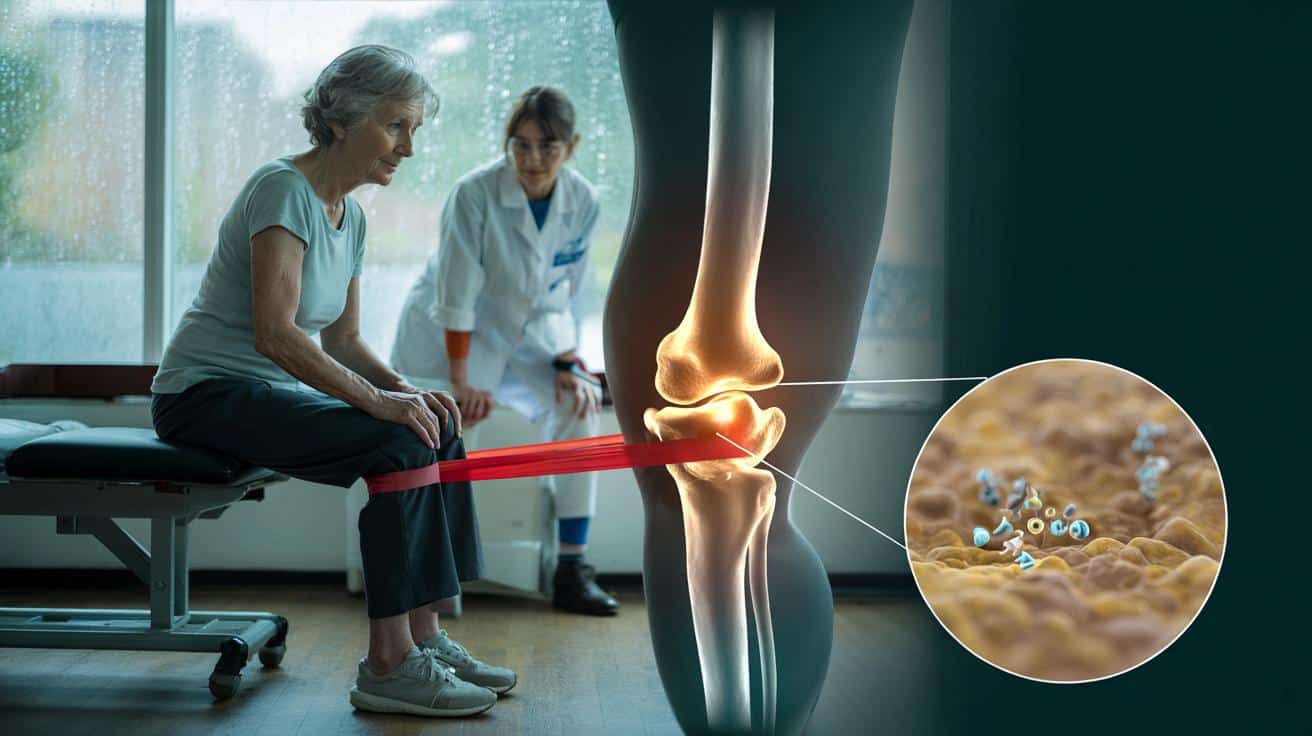
A new line of research suggests we might not need to accept that slow fade. Scientists say they’ve found a way to nudge the body’s own bone-making machinery back to work, not just to stall loss but to rebuild strength where it’s been lost. The idea is deceptively simple: switch on the signal bones use to sense movement, and let the body do the rest.
On a drizzly Tuesday in London, I watched a physio loop a resistance band around an elderly patient’s knees. She steadied herself, breathed, and pushed outwards. The room was quiet except for the rubber’s soft creak, but something louder was happening under the surface. Each tiny push was a whisper to her bones: “Wake up.” The physio smiled, not because the move was glamorous, but because it was real. Bones listen to load. They always have. What if we could turn up that volume safely and precisely?
The quiet switch inside our bones
Researchers are focusing on a molecular “switch” that bone cells use to sense force. It sits in the membrane of osteoblasts—the builders of bone—and opens when you move, setting off a cascade that encourages fresh, dense tissue. Dubbed a mechanosensitive pathway, it links directly to the Wnt network, the one that flips bone-building on and keeps bone-eating cells from running riot. Flip it on in the right place, and you don’t just slow loss. You make more bone.
In animal models with age-related bone thinning, activating this switch restored strength in hips and spine far beyond what gentle exercise could manage alone. Think mouse femurs that stop snapping under stress tests, or fragile vertebrae that regain bite. Early teams are experimenting with tiny bone-seeking carriers that ferry a “go” signal straight to the skeleton—so the rest of the body doesn’t get dragged into the party. It’s **bone-building** where it’s needed, not everywhere at once.
The logic is comforting in its elegance. Bone is living tissue, and it loves a reason to grow. Mechanical cues—steps, squats, even subtle vibration—start the conversation. The new science aims to bottle that nudge in a form the body recognises, then deliver it locally. No sledgehammer chemistry. Just a targeted push that amplifies your own biology. *Bones are not statues; they’re responsive, hungry, keyed to your every move.*
From lab bench to living room
The most promising methods do two things at once: they prime osteoblasts to build and ask osteoclasts—the demolition crew—to calm down. One approach uses a small molecule that tickles the bone’s force sensor, the way a brisk walk does, but with more staying power. A second strategy tags the molecule to a bone-homing “postcode” so it parks on the mineral surface instead of floating about the bloodstream. That pairing could mean strong results with far fewer unwanted ripples elsewhere.
We’ve all had that moment when a doctor says, “Keep moving, your bones will thank you,” and you nod, hoping it lands. The rough truth is that many people with osteoporosis can’t load a hip or spine enough to wake it properly. Pain blocks the path. This science tries to meet you halfway—prime the cells, then let everyday movement finish the job. Let’s be honest: nobody does that every day. But a short walk plus a primed switch is a different equation.
Clinicians I spoke to see a clear opportunity as long as safety pilots the ship. They like that the discovery doesn’t throw out current care—calcium and vitamin D, fall-proofing, strength training, and existing medicines—but adds a lever that aligns with how bone naturally behaves.
“What excites me is the **real-world impact** potential,” says a London-based endocrinologist. “If you can help people rebuild at sites that break most—hips, wrists, spine—you change lives, not just bone scans.”
- Local action: Focus on bone surfaces to cut systemic side effects.
- Synergy: Pair with light loading to multiply gains.
- Safety first: Short pulses, watchful dosing, and clear stop rules.
What it could mean next
There’s a reason this story is travelling fast. It taps into something both ancient and new—the body’s love of movement plus a smart, targeted nudge. Trials will need to show durability, not a sugar rush that fades in months. It also has to work for people on common treatments, from bisphosphonates to the sclerostin-blocking injections already used in severe cases. None of this is a done deal. It’s **early days**, and human bones don’t always play by mouse rules.
Think of the doors this opens. If we can focus the bone-making signal on the hips of a 78-year-old who’s fallen twice, we might cut a long hospital stay to a blip and send her back to her garden. If a man on steroid therapy can rebuild lost density before his next winter, fewer chest infections turn into fractures from a violent cough. The discovery doesn’t promise a miracle. It points at a path that feels human, grounded, and strangely hopeful.
You can picture what a good version of this looks like: a safe, local, on–off switch that teams up with habits we know already help—short strength sessions, protein at breakfast, a daily walk, a night’s sleep that lets bone do its quiet repair. Not heroic. Not flashy. Just enough to edge the balance back towards strength. And that might be all the difference.
| Key Point | Details | Interest for the reader |
|---|---|---|
| Targeting the bone’s force sensor | Activates a mechanosensitive pathway tied to Wnt, nudging osteoblasts to build and damping excess resorption. | Hope for rebuilding—not just slowing—bone loss where fractures happen most. |
| Local, bone-seeking delivery | Molecules tagged to mineral surfaces aim for site-specific action and fewer whole-body effects. | Potentially better tolerability and outcomes in daily life. |
| Pairing with simple loading | Light strength work or walking may amplify the signal, translating lab gains into everyday strength. | Practical steps you can start now to stack the odds in your favour. |
FAQ :
- Is this a cure for osteoporosis?Not a cure, but a new way to shift the balance towards bone gain. It aims to work with your biology rather than override it.
- When might this reach patients in the UK?Timelines depend on trials. If early studies go well, limited access could start within a few years, then widen through the NHS.
- How is it different from current drugs?Traditional treatments often slow bone breakdown. This approach is designed to spark new bone formation locally, then team up with gentle loading.
- Will it replace exercise and nutrition?No. Think partnership. A primed bone cell plus protein, vitamin D, and sensible strength work is a stronger combo than any one piece alone.
- Any known side effects?Early work focuses on local delivery to reduce risks, with short dosing windows and careful monitoring. Safety data will set the pace.





Fascinating approach—target the bone’s force sensor and let movement finish the job. The local, bone‑seeking delivery is the bit that feels defintely new to me, especially if it lowers systemic side effects. As someone who can’t always lift heavy, the “prime then walk” idea sounds doable. Please keep reporting on durability beyond 12–24 months and whether it plays nicely with bisphosphonates.
How is this substantively different from sclerostin blockers—just Wnt by another route? Any fracture endpoint data yet?