
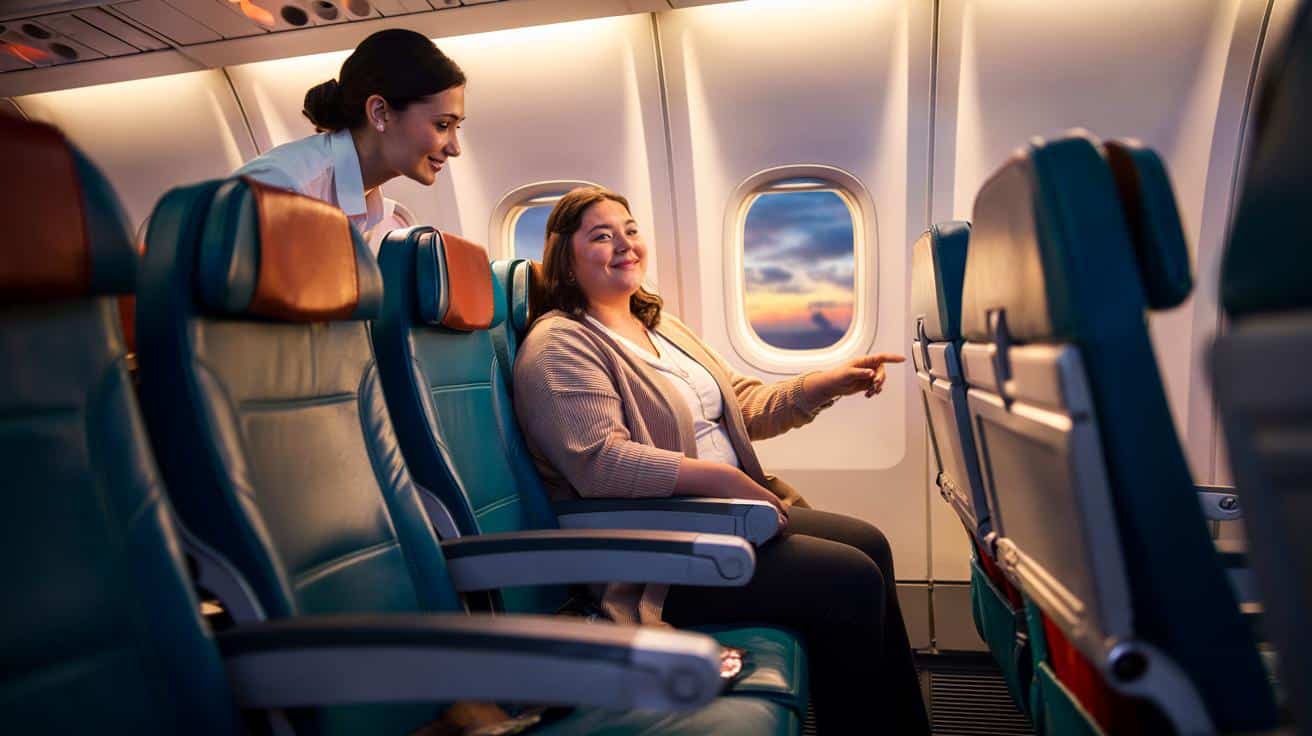
Seats are narrower, planes are fuller, and bodies are different. A major international airline is now preparing to roll out a policy tailored for plus-size passengers — with extra-seat options, better booking tools, and a promise of dignity. For some, it reads like overdue respect. For others, it prods the sensitive question everyone tries to ignore between check-in and touchdown.
It started with something small: the soft click of an armrest refusing to lift. Two strangers, stiff smiles, a shared apology for elbows that don’t fit anywhere. The cabin lights dim, and the cabin gets louder — the gentle chorus of people finding space that isn’t really there. I watched a woman shift, then shrink, then pull her cardigan across her lap like a curtain. No one said a word. Everyone felt it.
On the next flight, a man quietly asked a crew member for a seatbelt extender. She nodded, like it was nothing, which made it everything. It got me thinking about the little rituals of flying — the tray tables, the trolley, the taxi to the runway — and the big emotions woven in between. *What if the airline changed the script?* Here’s what’s about to change.
A policy shaped by real bodies, not diagrams
The airline’s plan is simple to read and complex to run: create a clearer path for larger passengers to travel comfortably without public negotiation. That means an optional second seat at a discount, automatic refunds if the flight goes out with empty seats, and priority access to rows with lifting armrests. It also means friendly pre-boarding and crew trained to offer help without fuss.
There’s a booking tweak, too. Customers will see seat width and pitch shown in the seat map, not buried in a FAQ, along with clear markers for aisle-side armrests that raise. The airline is testing a tool that suggests roomier rows based on aircraft type, like an “ease” score. One cabin manager told me the aim is to make this a choice you click, not a conversation you dread.
Behind the PR sits a practical truth: modern economy seats average about 17–18.5 inches wide, and planes are busier than ever. The World Health Organization says global rates of obesity have risen sharply since the 1970s. Those two lines — narrower seats, larger bodies — meet at the armrest. The airline’s policy nods to safety rules on belts and aisles, but it’s also a value statement. **Comfort isn’t a luxury if it’s the price of dignity.**
What the new policy actually changes
Here’s the gist of how it works if you opt in. During booking, you can select a “Two Seats, One Passenger” option with a reduced total fare compared with buying two separate tickets. If the flight later departs with spare seats, you get an automatic partial refund. You’ll see a clear badge next to seats where the aisle armrest lifts, and where seatbelts have a small extender built in.
The policy folds in human moments. Crew will quietly distribute extenders, pre-boarding invites you on early, and gate staff can block an adjacent seat if there’s slack in the cabin. No medical notes. No weigh-ins. Just a system that tries to move the hard part out of public view and into the booking flow. We’ve all lived that moment when you measure your space in inches and goodwill.
There are still traps, and they’re not all visible. Some people will wait, hoping the seat next to them stays free, then watch it fill at T-10 minutes. Others will buy two seats and feel judged for paying extra to fit a space that never fit them. Revenue teams worry about what happens on routes with constant full loads. Crew worry about being both enforcers and carers in one breath. “Let’s be honest: nobody does this every day.”
“This is about certainty,” says a senior cabin crew trainer. “If a passenger knows they’ll sit without pain or embarrassment, everything else feels like flying again.”
- Optional discounted second seat, with automatic refund if unsold seats remain
- Seat maps showing width, pitch, and liftable armrests
- Discreet distribution of extenders and early boarding
- Staff training focused on consent and language
- Clear, no-surprise re-seating rules at the gate
Why this matters beyond the aisle
This isn’t charity; it’s systems thinking. Airlines live on tight margins, strict weight-and-balance rules, and aircraft interiors set years in advance. A policy like this cuts along all three. It signals investment in training and tech, not a wholesale refit, because seat frames won’t widen overnight. It also leans on data — how often two-seat bookings happen, where refunds trigger, which rows get requested most.
There’s also a cultural pivot. Public shaming in the aisle helps no one, and the airline knows the risk of a viral moment. If the policy works, the peace starts at booking and flows through to boarding. That means fewer whispered negotiations, fewer last-minute swaps, and fewer complaints that simmer from pushback to landing. **Quiet logistics can feel like kindness.**
The harder question is equity. If comfort requires paying for an extra seat, is that fair? The airline’s answer is to charge less than two full fares and to automate refunds where capacity allows. It’s not perfect. But it draws a line you can see: here’s the price, here’s what you get, here’s how we protect your privacy. In aviation, clarity is a kind of compassion.
How to use it well, without stress
Start at the seat map. Look for the new icons showing seat width and the little hinge symbol for lifting armrests. If you’re on a narrowbody aeroplane with a 3–3 layout, aim for rows the airline flags as “flex” — often near the front and the very back. If you book two seats, add your name to both in the booking so boarding scanners read the pair as yours.
Pick times that give you the best shot at refunds. Midday flights midweek trend lighter than Sunday evenings. If your plans can stretch, pick a departure with a high “ease” score on the booking page. Don’t wrestle the armrest at speed; ask a crew member to help release the latch on older frames. **Small gestures from trained staff can change the whole flight.**
Common misstep: waiting until the gate to ask for space. By then, the algorithm has already filled most seats, and the team is firefighting. Another one: assuming every extender is the same length; some are longer and not every cabin has plenty. Be kind to yourself on the day you fly. The aisle is a spotlight, and no one performs well under it.
One crew lead told me something that stuck with me:
“We’re not measuring bodies — we’re measuring comfort. If the solution is quiet, we’ve done our job.”
- Use the booking toggle for “Two Seats, One Passenger” when comfort is non-negotiable.
- Watch for aircraft type changes in your app; re-check the seat map after swaps.
- Request pre-boarding in the app so you can sit without the rush.
- On board, ask for the longer extender if the standard one pinches.
- If your second seat goes unused on a not-full flight, expect an automated refund.
The ripple effect — and what comes next
This policy nudges the industry to admit something it has sidestepped for years: seats are designed for averages, and averages are myths. When one carrier rewrites its playbook, competitors watch the numbers. If complaint rates fall, if word-of-mouth softens, if loyalty bumps on routes with frequent plus-size travel, copycats will follow. That’s how change takes off in aviation — not with a sermon, but with a spreadsheet.
It could also pull other threads. Better transparency on seat width helps parents with car seats, elderly travellers with mobility limits, and anyone who simply hates being cramped. Honest labelling unspooks the experience. And yes, it will spark the old arguments about personal responsibility and shared space. Those tend to miss the point. Air travel is a public square with wings, and public squares work when people are treated like people.
The airline isn’t promising miracles, just fewer awkward moments and more predictable comfort. Policies like this live or die in the grey areas — at 6 a.m. in Glasgow when a plane change shrinks the seat map, or at 9 p.m. in Malaga when a hen party grabs the last free middle seat. Still, the arc is clear. Make the choice visible. Make the help routine. Make the dignity quiet enough to feel normal.
| Key Point | Details | Interest for the reader |
|---|---|---|
| Discounted extra-seat option | “Two Seats, One Passenger” priced below two full fares, with automatic partial refunds on lightly loaded flights | Saves money while guaranteeing space without awkward last-minute negotiations |
| Transparent seat information | Seat width, pitch, and liftable armrests displayed on the seat map, plus an “ease” score by aircraft type | Makes it easy to choose comfort upfront rather than gamble at the gate |
| Discreet service on board | Quiet distribution of extenders, early boarding, and trained language for sensitive interactions | Reduces stress, embarrassment, and the chance of a viral aisle-side showdown |
FAQ :
- Will I have to prove my size to book two seats?No. The policy relies on self-selection. You pick the option in the booking flow, no measurements or medical notes required.
- What if I buy two seats and the flight isn’t full?You’ll receive an automatic partial refund after departure if spare seats remained unsold. The second seat still guarantees space in advance.
- Can I use my second seat for a carry-on or service animal?The second seat is for personal space and comfort. Standard cabin baggage rules still apply, and animals must follow existing policies.
- Do all seats have lifting armrests and longer extenders?No. The seat map shows which rows have liftable aisle armrests. Extenders vary by cabin, and crew can provide longer ones on request.
- Will this raise ticket prices for everyone else?Fares move with demand and fuel, not a single policy. The airline’s model expects the extra-seat discount and refunds to balance with overall load factors.




Definately overdue. Transparent seat width, pitch, and liftable armrest icons should reduce the gate-side embarassment. Also love the auto-refund if seats go empty—quiet logistics that respect people. More of this, less aisle-side negotiation, pls.
Honest question: if larger passengers must still pay more (even discounted), how is that fair? Why not set aside a few wider rows at no extra cost to actually accomodate variance in bodies?