
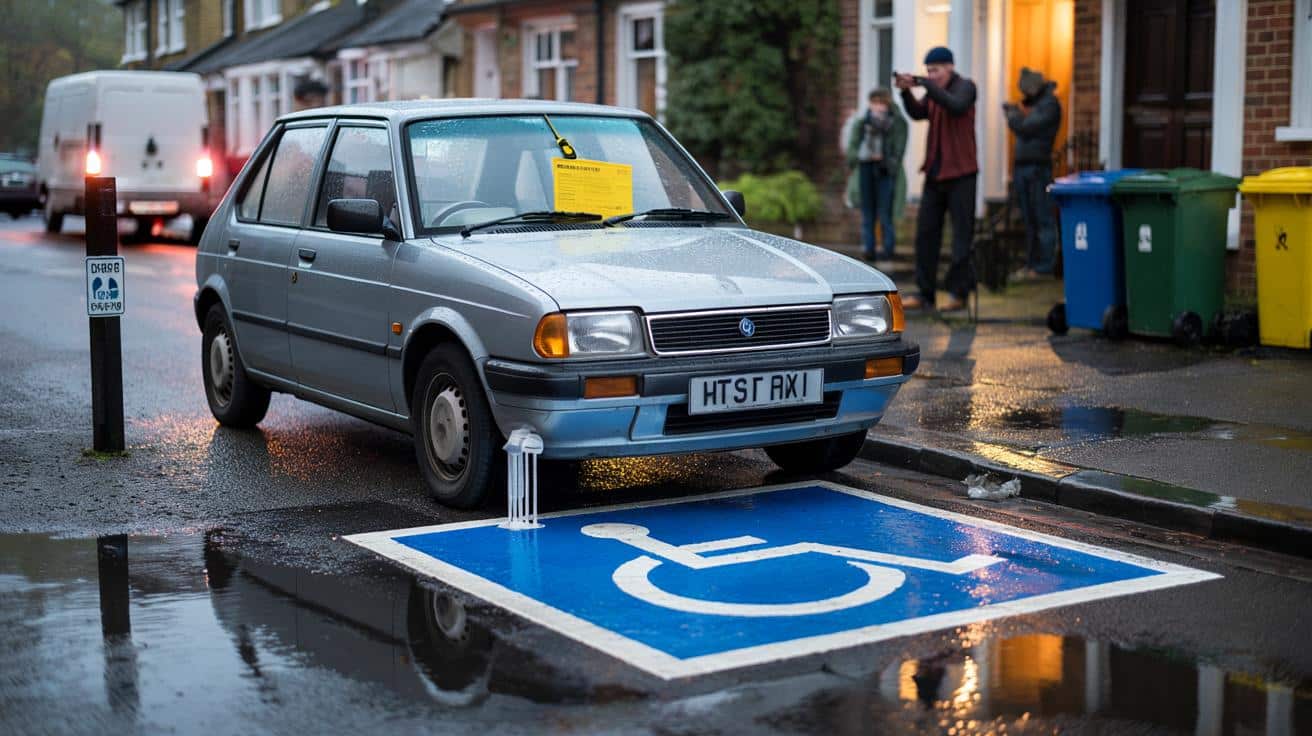
It’s the kind of story that travels fast because it pricks a shared sense of fairness. Where does common sense end and enforcement begin?
It was a wet weekday morning on a quiet terraced street, the sort where builders’ vans nose into gaps and kids weave scooters between wheelie bins. A small hatchback sat where it always does, rain freckling the windscreen. Overnight, fresh lines had appeared — crisp white boundaries and a blue wheelchair symbol hugging the kerb, paint still tacky near the tyres.
The owner came back balancing a paper cup and a loaf, paused, and stared at the bright yellow envelope under his wiper. Neighbours tutted. Someone filmed, of course. The air smelled faintly of solvent, the kind that lingers after hasty roadworks. A new sign had been bolted to the post at first light. One detail felt like a punchline.
The bay appeared around the car.
This is the uncomfortable grey zone of street life: when the rules change while your car is sleeping. Drivers park legally one evening, only to wake and find themselves “in” a disabled bay that didn’t exist the night before. Fines follow. Outrage follows the fines. Then the squabble about who knew what, and when.
It’s not just one street or one council. Social feeds are dotted with clips showing paint sprayed around bumpers and tyres, with commenters spotting telltale overspray on rubber. Residents swear there was no sign at 10 p.m., then there was one by 7 a.m. We’ve all had that moment when the world shifts a little under your feet, and you’re expected to act as if you were warned.
Legally, it boils down to timing, signage, and the adequacy of notice. Road markings and signs must be in place and clear before a contravention can occur. A disabled bay is not just paint; it rests on a traffic order, lawful lines and a sign that means what it says. If you parked before those existed, you didn’t park “in” anything at all. **If the bay did not exist when you parked, the contravention likely didn’t occur.**
There’s a practical way to handle the shock. Start with evidence. Note the date and precise time you parked. Take photos of the fresh paint — look for splashes on tyres, ragged edges, wet sheens, even boot prints. Photograph the signpost, both sides, and the base where new fixings or disturbed dust can reveal a recent install. Grab wider shots showing context: door numbers, shopfronts, the position of the sun or puddles.
Ask for the Civil Enforcement Officer’s photos and the work order. Councils hold CEO images and often body-worn video; these carry timestamps and sometimes capture painters on site. Request the job card from the contractor that installed the bay, plus the traffic order date. **Ask for the CEO’s photos and the work order dates.** This isn’t being difficult; it’s reconstructing the timeline, and timelines decide these cases.
Let’s be honest: no one actually keeps a daily log of street signs. That’s why the law leans on reasonable notice. Where bays are introduced or suspended, authorities are expected to warn residents in advance — think A4 signs on posts, letters to households, cones that say more than “No parking”. If you never saw such warnings, say so. Consider a Subject Access Request for your own case footage, and if needed, a Freedom of Information request for the work schedule. A clean, clear narrative beats a long rant.
Contesting a ticket looks tricky, yet it follows a simple path. Make an informal challenge straight away. Keep it factual and short. “I parked at X:XX on [date] when there were no lines or signs. Overnight, a disabled bay was painted around my vehicle, and the sign was installed. Your photos show fresh paint on my tyres.” Attach images, reference times, and mention the principle of adequate signage. The discount period usually pauses while your appeal is considered.
If rejected, the Notice to Owner arrives. That’s the formal stage. Repeat your case with detail and structure: times, photos, location, lack of prior notice. Refer to the Traffic Signs Regulations and General Directions 2016 and the duty to provide clear, lawful signage before enforcement. If you go to the independent adjudicator (Traffic Penalty Tribunal outside London; London Tribunals in the capital), you’ll be asked one question in many forms: was the contravention properly signed at the time of parking?
“Adjudicators consistently look at the state of the signs and lines when the vehicle was left. Fresh paint and last-minute signs are powerful clues.”
Think like an investigator, not a keyboard warrior. Keep your tone level, your pictures sharp, your timeline precise. **Do not pay ‘just to make it go away’ if your evidence shows the bay appeared after you parked.**
- Photograph everything before you move the car.
- Request CEO photos and any bodycam footage.
- Ask for the traffic order and the contractor’s install date.
- Point to overspray on tyres or kerbs as timing evidence.
- Escalate to adjudication if the council won’t budge.
Stories like these say a lot about how we share a street. The law needs clarity. People need fairness. Councils need to manage change without catching the blameless in a net meant for the careless. When a disabled bay appears, it should come with warning notices and breathing room, not a flurry of tickets and a viral clip.
There’s a human fix, plain and practical. Advance notices that actually stick. Temporary cones that explain what’s coming and when. Overnight works that are paused around existing cars, with enforcement delayed until the first clear day. And if a mistake happens, a quick cancellation rather than a protracted back-and-forth. We don’t need a culture war about parking. We need trust.
On many streets, neighbours already look out for one another — texting, knocking, pushing an alert through a letterbox. That’s the grain of everyday life policy should follow. If you’ve lived through a bay painted around your car, or watched it from your window, share the timeline, the fix, the thing that worked. Small details travel fast, and they often change more than one mind.
| Key Point | Details | Interest for the reader |
|---|---|---|
| Timing decides liability | If you parked before lines/signs existed, the contravention may not have occurred. | Clear route to contest a ticket without legal jargon. |
| Evidence beats outrage | Photos, CEO images, bodycam, and work orders build a timeline. | Practical steps you can take today. |
| Use the appeal ladder | Informal challenge, Notice to Owner, adjudicator tribunal. | Confidence to escalate when you’re in the right. |
FAQ :
- What should I do as soon as I spot a ticket in a freshly painted disabled bay?Take photos immediately: tyres, edges of paint, signpost, wide context. Note exact times, and keep the ticket envelope. Then submit an informal challenge with your timeline.
- Can a council enforce a disabled bay painted around my parked car?Only if proper signs and lines were in place when you parked. If they weren’t, you can argue the contravention didn’t occur due to inadequate signage at the relevant time.
- Does having a Blue Badge change anything here?A Blue Badge lets you use disabled bays lawfully. This situation is about timing and signage: whether the bay legally existed when you left the car.
- Will I lose the discount if I appeal?Most councils re-offer the discount if you challenge within 14 days and they reject, but policies vary. Check the ticket and the council’s site before you act.
- Can I recover costs if I win at adjudication?Costs are rare and only awarded for unreasonable behaviour by the council. Focus on winning on the evidence; that’s what matters most.








Is there a legal minimum notice before a new disabled bay is enforcable? If the Traffic Order and the sign install are dated after the car was left, the contravention didn’t occur—right? Any links to the exact regs (TSRGD 2016, adjudicator cases) would help; “adequate signage” gets used way too loosely.