
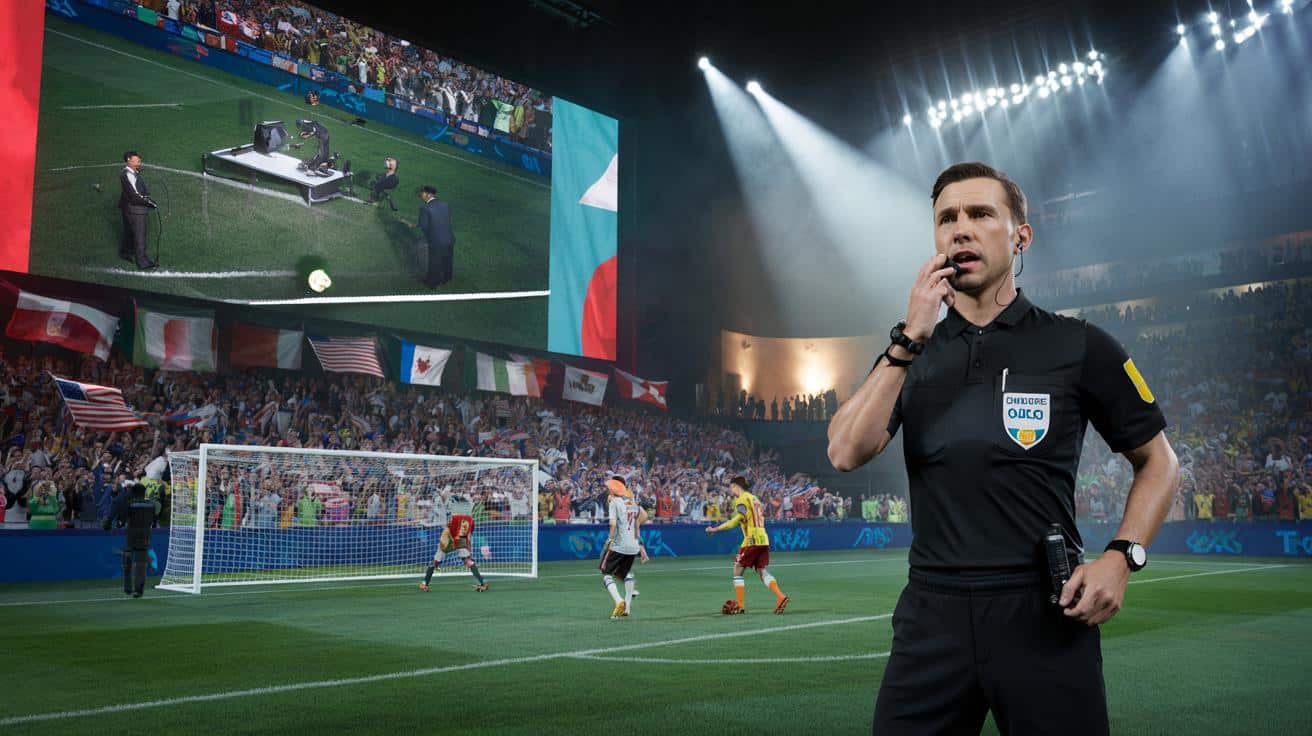
A goal goes in, the referee touches their ear, the stadium turns into a waiting room. Two minutes feel like ten. At home, the kettle boils. In pubs, speculation bubbles louder than the commentary. Now FIFA says it’s changing the soundtrack at the biggest show of all: **every 2026 World Cup match** will feature on‑mic explanations from the referee after a VAR check. The decision, the reason, the restart — spoken out loud, in the ground and on your TV. Simple idea, big stakes.
The first time you hear it, it’s almost jarring. A referee plants their feet, the roar dips, and a plain, steady voice fills the bowl: “Decision: Penalty. Foul by number five, tripping. Restart: penalty kick.” No theatrics. No mystery. Just words, delivered in a few seconds that could change a nation’s summer. In a Costa Rica café, spoons pause over coffee. In a Manchester living room, a family nods in sync. Then the voice cuts through.
The new rule, stripped back
FIFA says the 2026 World Cup will standardise something football has trialled in elite tournaments: the **referee on‑mic explanation** after a VAR intervention. When a check leads to a change — a goal ruled out, a penalty awarded, a red card restored or withdrawn — the referee will speak to the stadium and the broadcast. Short. Clear. Recorded. This is not a TED Talk at the centre circle; it’s a 10–12 second, accountable bridge between the Laws and the lives watching them.
We’ve seen the bones of it already. At the Women’s World Cup and age‑group finals, officials announced the outcome and reason, and the sky didn’t fall. In Wellington, a hush dropped into a crackling crowd before a penalty call was explained in a single breath; clips did the rounds within minutes, not as conspiracy bait, but as clarity. You felt the stadium exhale. One fan told me later she “finally knew what everyone was arguing about.” That’s not nothing.
Why now? Because silence leaves a vacuum, and football is tired of the wrong voices filling it. A quick, public explanation changes the emotional temperature. It can soften the edges of dissent, protect referees from the mobbing that became normal, and remind players what the decision is actually about. It also travels. The words sit on the broadcast, the highlights, the social scroll — evidence you can replay. For a tournament that will stretch across three countries and four time zones, that kind of portable **transparency** matters.
How it plays out — and how to follow it without missing a beat
Think in beats. The referee will wait for the check to conclude, step into a quiet pocket, then deliver three things in order: the decision (foul/no foul; goal/no goal), the offence (“handling by number 7”; “offside in APP”), and the restart (“penalty”; “indirect free‑kick”). If you’re in the ground, turn to the PA rather than the big screen; many stadiums will mirror the phrasing, but the mic is the prime source. At home, listen for that clipped cadence — it’s designed to be understood on a phone speaker at 1 a.m.
Two small tricks cut through the noise. First, anchor on the restart: it tells you what happens next and calms the room. Second, clock the law keyword — “deliberate play”, “point of contact”, “APP” — then move on. Soyons honnêtes : personne ne fait vraiment ça tous les jours. We all want certainty, not a seminar. If you’re a coach or captain, use those words as your cue to reset shape, not a platform to plead. We’ve all had that moment where emotions flood in; a clear sentence can be a life raft.
Here’s what not to do, even if your heart is racing. Don’t over‑read tone; referees aren’t performing, they’re documenting. Don’t assume delay equals doubt; comms latency and translation can lag a beat. Don’t amplify chopped clips; context is king and edits lie.
“The announcement won’t end debate — it frames it,” says former FIFA referee Bibiana Steinhaus-Webb. “In the biggest moments, a clean explanation lowers the temperature and raises understanding.”
And because big nights scramble brains, keep a tiny crib in mind:
- Decision: what changed
- Offence: why it changed
- Restart: what happens next
- Move: reset your head and the team
What it shifts — for players, coaches, and the rest of us
This rule nudges trust back towards the centre. Referees become less like distant judges and more like human officials letting us into the room. That matters when 80,000 people are vibrating with tension and millions more are holding their breath at 03:17. It also sets a tone for behaviour. If the captain hears “Simulation — yellow card,” that’s a public line in the sand. If a bench hears “Deliberate play — onside,” the tactical argument changes on the spot. It sounds small, but it lands big.
At tournament scale, words can be infrastructure. A simple announcement travels cleanly across three host nations, different languages, and vastly different football cultures. It gives the same bones to every tight call, from Toronto to Monterrey to Los Angeles, and it reduces the oxygen available for bad‑faith commentary. Will debates vanish? Of course not. That’s football. But the debate starts from a common sentence, not a fog. And that, for a month when every second is stretched by feeling, is worth more than it seems.
There’s a human effect too. Players know what they’re being judged on. Coaches can brief with real examples that include the actual words they will hear. Parents in fan zones can explain a high‑stakes call to a child without shrugging. And those of us who watch because it brings us together get fewer seconds of bafflement and more of the game itself. Let’s be honest: nobody does that every day.
Open lanes and live questions
Will the announcement style evolve as the tournament goes? Probably. Short, plain and repeatable is the north star, yet a World Cup is a living thing, and referees are people. Voices shake. Words run together. A gust of noise eats a syllable. That’s fine. What matters is that the game becomes a little less opaque in the hardest moments, when hearts are roaring and inches decide summers.
There’s room for curiosity here. What phrases travel best across languages? How do fans react when they hear the reason they don’t like, but hear it straight? Does the presence of a public sentence change how quickly players accept a restart? These are not just officiating questions; they’re culture questions. The World Cup is always a mirror. This time, it might be a microphone too. And if the new rule does what it promises, the silence after the whistle could feel different — less tense, more honest.
| Key Point | Details | Interest for the reader |
|---|---|---|
| Referee announcements after VAR | Three-part message: decision, offence, restart; delivered on PA and broadcast | Know exactly what happened without waiting for pundits or clips |
| Consistency across venues | Standard wording and protocol at every 2026 World Cup match | Fewer mixed messages, more confidence in tight calls |
| Behavioural impact | Public clarity can reduce dissent and speed restarts | Cleaner game flow and less second‑hand confusion in the stands or at home |
FAQ :
- What exactly is the “new rule” for 2026?Referees will give a short, scripted explanation over the stadium PA and broadcast after a VAR intervention changes a decision — the outcome, the reason, and the restart.
- Will I hear this in the stadium and on TV?Yes. The announcement is designed for both environments, so fans in the ground and viewers at home get the same core information.
- Does this slow the game down?No. The message is typically 10–12 seconds and follows the check; it replaces confusion, not playing time.
- Will the explanation be in multiple languages?Announcements are in the match language, with broadcast graphics and comms supporting wider audiences. Key phrasing is kept simple to travel well.
- Does this change what VAR can review?No. It changes how the outcome of a VAR‑led change is communicated, not the scope of checks set by the Laws of the Game.







Finally! Clear, concise announcements after VAR are exactly what fans needed. The shouty void between check and decision has been exhausting. If captains hear “Simulation — yellow,” maybe we get less mobbing and faster restarts. This is the closest football’s come to NFL‑style mic clarity, and I’m definitly here for it.